.png)
Advanced Google Ads Mastery: The Ultimate Google Ads Strategy for Ecommerce in 2026
Advanced Google Ads Mastery: The Ultimate Google Ads Strategy for Ecommerce in 2026
Google Ads has evolved.
In 2026, running E commerce Google Ads is no longer about selecting keywords and increasing budgets. It's about system design, signal engineering, and revenue architecture.
If you're asking:
- Is Google Ads good for ecommerce?
- What steps should I follow to build a revenue focused Google Ads strategy for my online store?
- How to optimize Google Ads for e commerce?
- What is a good CPA for Google Ads?
This guide answers all of it — technically and practically.
This is your complete blueprint for Advanced Google Ads Mastery.
Is Google Ads Good for Ecommerce?
Short answer: Yes — but only when structured correctly.
Google Ads works exceptionally well for ecommerce because:
- It captures high-intent traffic
- It integrates directly with product feeds
- It supports revenue-based bidding (tROAS)
- It allows performance tracking at SKU level
- It scales predictably with clean data
However, poor structure leads to inflated CPAs and unstable ROAS.
The difference between success and failure is not budget.
It's architecture.
If you want a deeper breakdown of how high-performance paid systems are structured, explore our detailed Google PPC strategy framework .
What Steps Should I Follow to Build a Revenue Focused Google Ads Strategy for My Online Store?
Here is a step-by-step Google Ads strategy for ecommerce businesses:
Step 1: Separate Brand and Non-Brand Traffic
Never mix them.
Brand traffic artificially inflates performance metrics.
If you combine Brand + Non-Brand:
- ROAS looks better than reality
- CPA looks artificially low
- Scaling decisions become flawed
Create:
- Brand campaign (Exact match only)
- Non-Brand high intent campaign
- Expansion campaign (Broad / PMax / DSA)
This is the foundation of Advanced Google Ads Mastery.
Step 2: Structure Campaigns Around Intent (Not Just Products)
Most ecommerce accounts group campaigns by category.
Instead, segment by intent:
High Intent (Bottom Funnel)
- Buy + product
- Product + price
- Product + online
These deserve:
- Highest budget priority
- Aggressive tROAS
- Exact + Phrase control
Commercial Investigation
- Best + product
- Product reviews
- Comparisons
Evaluate with blended ROAS, not last-click only.
Discovery Layer
- Broad match
- Dynamic Search Ads
- Performance Max
These expand reach and feed the bottom funnel.
This is how you optimize Google Ads for e commerce strategically.
Google Shopping Ads Guide (2026 Version)
If you're running E commerce Google Ads, Shopping & Performance Max are critical.
But your product feed is your real ad.
Feed Optimization Checklist
- Optimized product titles (intent + attributes)
- Structured product_type hierarchy
- Custom labels (margin, seasonality, bestseller)
- GTIN completeness
- Variant grouping control
- Competitive pricing signals
Feed Segmentation Strategy
Instead of one campaign for everything, split:
- High Margin SKUs
- Best Sellers
- Clearance Products
- New Arrivals
- High AOV Collections
Then build separate Performance Max campaigns.
One PMax for entire store = lazy management.
Ecommerce Google Ads Strategy Example
Account Structure Example
- Brand Search (Exact only)
- Non-Brand High Intent (Exact + Phrase)
- Broad Expansion Campaign
- Performance Max – High Margin
- Performance Max – Best Sellers
- Remarketing (Search + Display)
- DSA for query mining
This structure:
- Improves budget clarity
- Stabilizes ROAS
- Makes scaling predictable
This is what separates beginners from Advanced Google Ads Mastery level advertisers.
Google Ads Strategy for New Businesses
If you're a new store with low data:
Do NOT jump into aggressive tROAS.
Phase 1:
- Manual CPC or Maximize Clicks
- Exact + Phrase match only
- Focus on high intent
Phase 2 (After 30–50 conversions/month):
- Switch to Maximize Conversions
- Enable Enhanced Conversions
- Improve tracking hygiene
Phase 3:
- Move to tROAS once value data stabilizes
New businesses fail when they use automation without signals.
🚀 Want a Revenue-Focused Google Ads Strategy for Your Ecommerce Brand?
Book a free strategy call with OptiFOX and get a Google Ads + Performance Max growth roadmap built specifically for your store.
📞 Book a Free Strategy CallNo fluff. Just scalable revenue architecture.
How to Improve Google Ads Performance (Advanced Diagnostics)
If performance drops, check:
1. Search Lost IS (Budget)
If high → Increase budget 15–20%
2. Search Lost IS (Rank)
If high → Improve ad copy, landing page, Quality Score
3. Absolute Top Impression Rate
If low → You're invisible in competitive auctions
4. Query Mining
Every 7–10 days:
- Add negatives
- Move winners to Exact
- Improve alignment
5. Conversion Signal Quality
- Enable Enhanced Conversions
- Use server-side tagging
- Remove duplicate events
- Reconcile GA4 vs Google Ads
Signal integrity is everything in 2026.
What is a Good CPA for Google Ads?
There is no universal CPA benchmark.
Calculate:
Break-even CPA = AOV × Profit Margin
Example:
- AOV = ₹3000
- Margin = 40%
- Break-even CPA = ₹1200
- If CPA = ₹900 → Profitable
- If CPA = ₹1500 → Losing money
CPA must be evaluated alongside LTV.
Ecommerce Google Ads Strategy Reddit vs Reality
Reddit often says:
- "Just use Performance Max"
- "Broad match solves everything"
- "Automation is enough"
Reality:
Automation works only when:
- Conversion tracking is clean
- Data volume is strong
- Account structure is logical
- Feed quality is optimized
Otherwise, automation amplifies mistakes.
Is Google Ads Enough for Ecommerce?
No.
Google captures intent.
Meta creates demand.
For a complete acquisition ecosystem, you must combine both.
Read this next:
👉 Top 10 Meta Ads Strategies for Ecommerce 2026
When you combine platforms correctly, you create a:
Demand → Capture → Retarget → Scale Loop
🚀 Ready to Turn Google Ads Into a Scalable Revenue Engine?
Book a free strategy call with OptiFOX and get a structured, revenue-focused Google Ads system built specifically for your ecommerce brand.
📞 Book Your Free Growth Strategy CallNo guesswork. No bloated structure. Just scalable acquisition architecture.
Final Thoughts: Advanced Google Ads Mastery in 2026
Winning ecommerce brands:
- Structure by intent
- Protect brand data
- Segment Performance Max
- Optimize feeds aggressively
- Engineer conversion value for profit
- Scale methodically
- Maintain signal discipline
Google Ads is not about pushing budget.
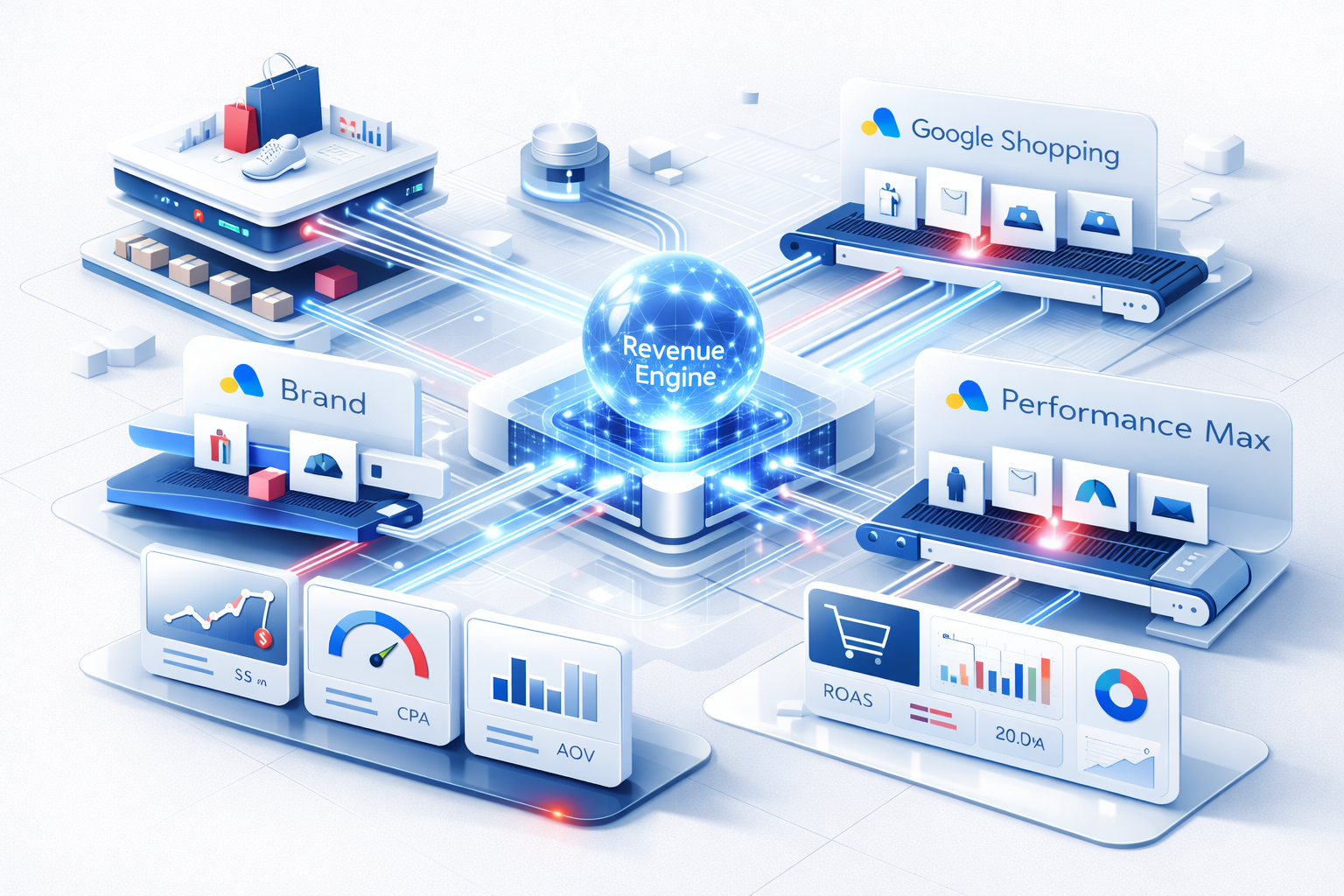
It's about building a revenue engine.
When implemented correctly, E-commerce Google Ads becomes predictable, scalable, and profit-focused.