.png)
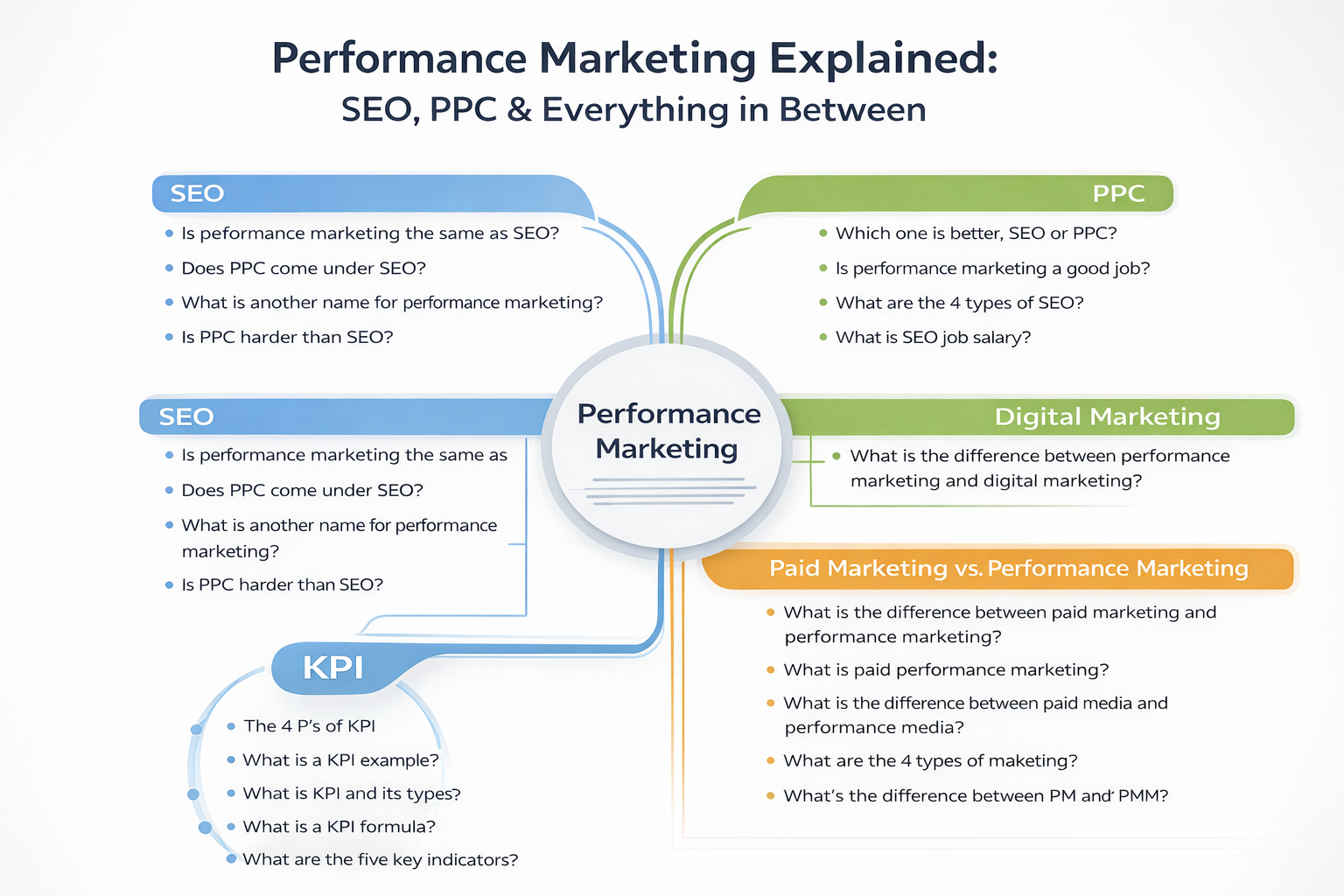
Performance Marketing Explained: SEO, PPC & Everything in Between
Performance marketing is one of the most data-driven strategies in modern digital advertising. Instead of paying for exposure alone, businesses pay only when measurable results occur — like clicks, leads, or sales. This results-focused approach ensures that every dollar in your marketing budget is tied to real outcomes and maximum ROI (Return on Investment).
In this guide, we’ll break down how performance marketing connects with SEO, PPC, digital marketing, key performance indicators (KPIs), and paid marketing — giving you actionable insights to optimize your campaigns.
When aligned correctly, performance marketing SEO allows brands to capture both immediate paid conversions and long-term organic visibility, creating a balanced and scalable growth strategy.
What Is Performance Marketing?
Performance marketing is a results-oriented digital strategy where advertisers pay only for specific, measurable outcomes — such as clicks, conversions, or sales. It emphasizes tracking, analytics, and campaign optimization.
Unlike traditional advertising — where payment is made for exposure regardless of results — performance marketing ties the cost directly to measurable performance, making it highly efficient and ROI-focused.
Key performance marketing channels:
- Pay-Per-Click (PPC) ads on search engines and social media
- Affiliate marketing and influencer partnerships
- Native advertising and display ads
- Retargeting campaigns
Is Performance Marketing the Same as SEO?
While SEO (Search Engine Optimization) improves organic visibility in search engines through content quality, keyword targeting, and website performance, it is not paid advertising. Performance marketing includes paid channels like PPC and affiliate ads where you pay only when a specific action occurs.
This distinction is often described as performance marketing vs SEO, where SEO focuses on sustainable organic growth and performance marketing focuses on measurable paid results.
Takeaway: SEO supports organic performance, while performance marketing drives measurable paid outcomes — both are essential in a full-funnel strategy.
Performance Marketing vs PPC
The comparison of performance marketing vs PPC is common, but PPC is actually a component of performance marketing rather than a competing strategy.
PPC is a channel where advertisers pay per click, while performance marketing is a broader framework that includes PPC, affiliate marketing, CPA campaigns, and conversion-based advertising models.
In short, PPC executes performance marketing goals, while performance marketing defines the overall results-driven approach.
Performance Marketing vs Digital Marketing
Both performance marketing and digital marketing operate online but serve different purposes:
Performance Marketing
- Focuses on measurable actions like clicks and conversions
- You pay only per result achieved
- Highly data-driven with strong tracking metrics
Digital Marketing
- Broader umbrella including SEO, email, content marketing, social media, and PPC
- Focuses on brand awareness, engagement, and long-term growth
- Includes performance marketing tactics but isn’t defined by them
In essence: performance marketing is a subset of digital marketing — one that’s focused on accountability and results.
Understanding KPI in Performance Marketing
Key Performance Indicators (KPIs) are quantifiable values that measure how effectively a campaign achieves its goals. Setting clear KPIs allows marketers to optimize based on real performance data.
- Conversion Rate: Percentage of users completing desired actions
- Cost Per Lead (CPL): Amount spent to generate each lead
- Customer Acquisition Cost (CAC): Cost to acquire a paying customer
- Click-Through Rate (CTR): How often users click your ads
Paid Marketing vs Performance Marketing
Paid marketing refers broadly to any advertising where money is spent to promote content or products. Performance marketing differs because you pay only when a measurable result happens.
- Paid Marketing: Pay for visibility regardless of direct outcome
- Performance Marketing: Pay only when action is completed
- Performance Media: Focus on measurable ad engagements
FAQs
- Is performance marketing the same as SEO? No — SEO drives organic visibility, while performance marketing focuses on paid actions and measurable results.
- Does PPC come under SEO? No — PPC is a paid tactic under performance marketing.
- Which one is better, SEO or PPC? Both are important: SEO builds long-term authority; PPC delivers immediate measurable results.
- What is an example of a KPI in performance marketing? Examples include CPC, CTR, CPL, and conversion rate.
- What are the 4 types of marketing? Digital, performance, inbound, and outbound marketing.
Conclusion
Performance marketing is at the core of modern, results-oriented advertising. By focusing on measurable outcomes and optimizing campaigns in real time, it ensures every marketing dollar contributes directly to business goals.
Whether integrating SEO through a performance marketing SEO strategy, tracking KPIs, or deciding between paid and performance channels, understanding these fundamentals empowers marketers to build efficient, scalable campaigns.